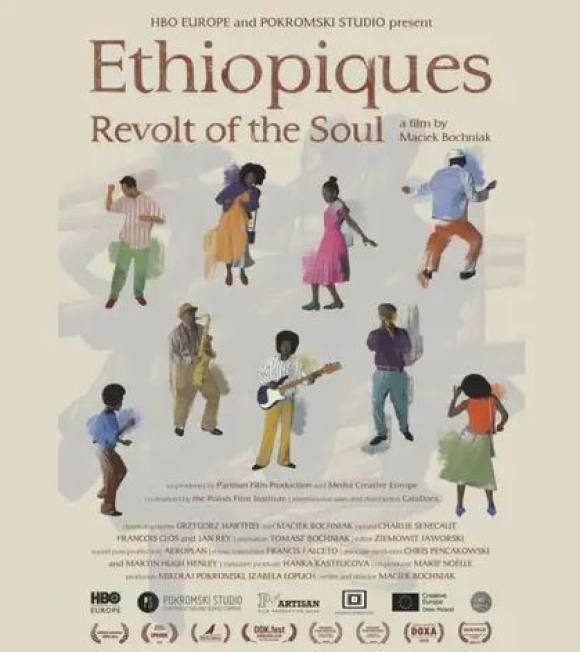
"Ethiopiques: Revolt of the Soul" is a highly acclaimed 2017 feature-length documentary directed by Polish filmmaker Maciej Bochniak. Produced in collaboration with HBO Europe, the 70-minute film chronicles the explosive rise, tragic silencing, and miraculous global resurrection of Ethio-jazz—a hypnotizing fusion of traditional Ethiopian five-tone scales with American soul, funk, and jazz.
At its heart, the documentary centers on an extraordinary cross-cultural partnership between two visionaries: the rebellious Ethiopian music producer Amha Eshete and the persistent French music enthusiast Francis Falceto.
The first act of the film transports viewers to the vibrant, booming nightlife of Addis Ababa in the late 1960s and early 1970s.
At the time, the imperial government of Emperor Haile Selassie maintained a strict monopoly on music publishing through state-sanctioned military and institutional bands.
Amha Eshete boldly broke the law by founding Amha Records, the country's first independent record label, alongside the landmark Harambee Music Store. He began recording local underground legends who were actively channeling the sounds of James Brown, Wilson Pickett, and Duke Ellington.
Between 1969 and 1975, Amha produced over 120 singles and 14 albums. This era gave rise to legendary figures like Mahmoud Ahmed, Alemayehu Eshete, Mulatu Astatke (the father of Ethio-jazz), and the iconic Walias Band.
The documentary takes a dark, emotional turn as it documents the sudden death of this golden cultural revolution.
Cultural Lockdown: In 1974, a brutal Marxist military junta known as the Derg overthrew the Emperor. They instituted strict curfews, locked down nightlife, censored artistic expression, and targeted musicians.
Flight and Erasure: Facing imminent danger, Amha Eshete fled into exile in the United States, eventually settling in Washington, D.C.. Several prominent musicians defected during external tours or went into hiding, effectively scattering the tapes, master reels, and physical history of Ethio-jazz across continents. For nearly two decades, this vibrant music was entirely forgotten by the rest of the world.
The narrative shifts to the mid-1980s, introducing French music journalist and promoter Francis Falceto.
Falceto happened upon a rare, scratched vinyl copy of Mahmoud Ahmed's 1975 album Erè Mèla Mèla. Captivated by its utterly unique, hauntingly beautiful brass lines and rhythms, he made it his life's mission to track down the masters and catalog the music.
The film details a meticulous, five-year quest spanning multiple continents. Falceto eventually united with the exiled Amha Eshete. Navigating complex legal battles, lost rights, and missing master tapes, the duo worked meticulously to resurrect the catalog.
This partnership birthed the famous Éthiopiques CD series via Buda Musique, which has grown to over 30 volumes. The series transformed what was once a localized, suppressed underground movement into a towering pillar of global world music.
While Falceto and Eshete drive the historical plot, the soul of the film belongs to Girma Beyene.
Girma was a legendary composer, pianist, and master arranger for the Walias Band during the golden era. Following the trauma of the revolution and the death of his wife, he fell into deep grief and artistic silence, working low-profile jobs in the U.S. for decades without touching a piano.
The climax of the documentary follows Falceto convincing a quiet, reluctant Girma to return to the stage. It beautifully captures his emotional artistic comeback, culminating in him recording Mistakes on Purpose (Volume 30 of the series) alongside the French group Akalé Wubé, bringing the narrative full circle.
The documentary highlights how the Éthiopiques series deeply moved and influenced major Western icons, featuring commentary from modern artists like Elvis Costello, who openly praises the profound compositional genius of the original Ethiopian tracks.
Director Maciej Bochniak relies heavily on a blend of rich archival footage, rare historic radio recordings, emotional present-day interviews, and playful animations that serve to visually recreate the missing historical gaps of 1960s Addis Ababa. Revolt of the Soul is far more than a standard music history documentary. It stands as a profound testament to the power of artistic resilience, showing how a handful of dedicated individuals prevented an authoritarian regime from permanently erasing a nation's cultural heartbeat.