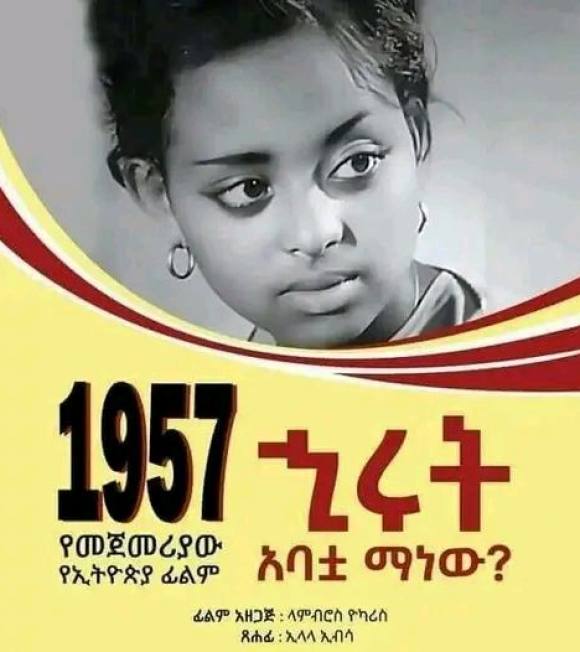
"Hirut, Abatwa Manew?" (Amharic: ሂሩት አባቷ ማነው?, translated as "Hirut, Who is Her Father?") occupies a historic milestone as the very first feature-length Ethiopian film in the country's history. The film was produced in 1964 and officially premiered at the Haile Selassie I Theatre (now known as the Ethiopian National Theatre) on August 29, 1965. A 35mm black-and-white feature drama running for approximately 80 to 90 minutes.
While cinema houses had existed in Ethiopia since the early 1900s—primarily screening foreign newsreels or silent documentary clips—this was the first time an entire, feature-length narrative was written, produced, and performed completely by Ethiopians in the Amharic language. Director, Writer, & Producer: The film was driven forward by Ilala Ibsa (Elala Ibsa), a visionary local Ethiopian businessman who financed, wrote, and directed the project. (Some archival accounts credit Greek filmmaker Lambros Jokaris with co-direction/technical assistance to navigate the complex 35mm cameras of the era). Abebech Ejigu delivered a landmark performance starring as the titular character, Hirut. It was organized under the Association of Country Film and Advertisement. The film is highly regarded by film historians for addressing intense social issues, class structures, and gender dynamics that were incredibly progressive for 1960s Ethiopia.
The story begins in the 1940s and centers around a young rural woman named Hirut. She meets an older man named Gugsa in Nazareth (Adama), they fall in love, become engaged, and have a daughter named Abeba.
Seeking a better future, the family moves to Addis Ababa, but tragedy strikes when Gugsa is arrested and sentenced to prison for 15 years. Left isolated and vulnerable in the developing capital without financial support, Hirut is cast into extreme poverty and societal vulnerabilities, struggling under the weight of severe class conflict.
Stripped of options, Hirut is pushed to the margins of society. Rather than succumbing to defeat, she fights to reclaim her autonomy by enrolling in school, ultimately transforming herself into a highly educated, modern, and self-sufficient woman.
Later, the narrative shifts toward her daughter, Abeba, as they relocate to Asmara. Growing up without her father present, Abeba faces intense local social stigma, constantly subjected to the painful, mocking neighborhood question that gives the film its title: "Who is her father?" The film beautifully deconstructs the psychological toll of this societal hypocrisy. A Time Capsule of Urbanization: Beyond the human drama, the film captured stunning, rare geographical footage of a rapidly modernizing East Africa. It features historic shots of early-1960s Addis Ababa—including the newly built Organisation of African Unity (OAU/African Union) headquarters—and the distinct mid-century streetscapes of Asmara.
Because the film tackled heavy, uncompromising realism and systemic exploitation rather than lighthearted theater, it was not initially a commercial hit with contemporary 1960s audiences, causing Ilala Ibsa to lose money on the venture. However, its artistic merit grew exponentially in historical value over time. Because of limited archiving infrastructure during the mid-to-late 20th century, the original film reels suffered degradation.
Recognizing its unparalleled cultural value, major archiving and digital preservation initiatives were launched around 2020. The film was successfully digitized, allowing it to be preserved frame-by-frame. The newly restored digital version had a grand celebratory re-premiere for contemporary viewers on January 5, 2022, at the Mulualem Cultural Center in Bahir Dar, cementing its permanent legacy in African cinema history.