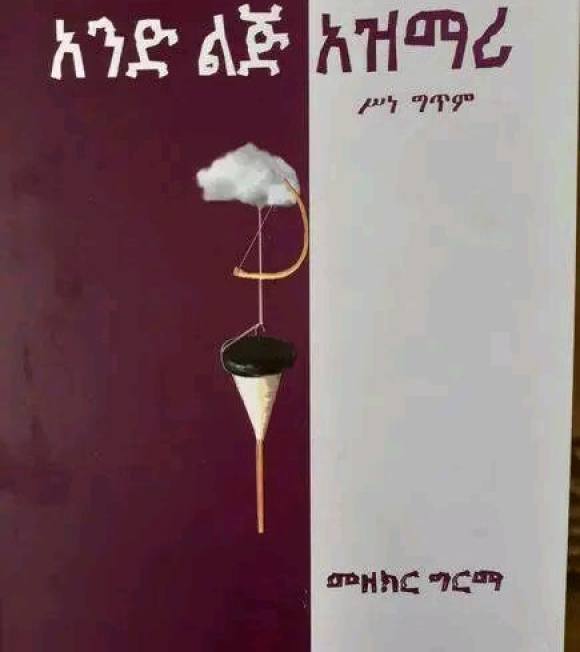
"And Lij Azmari" (አንድ ልጅ አዝማሪ), which roughly translates to "An Only Child, A Minstrel" or "The Lone Minstrel Child," is a highly acclaimed Amharic poetry collection by the prominent Ethiopian poet Mezekir Girma (መዘክር ግርማ).
Mezekir Girma is widely recognized in contemporary Ethiopian literature as a master craftsman of verse. His style balances profound philosophical depth with the rich, rhythmic traditions of classical Amharic wordplay. He frequently shares his masterpieces on iconic literary stages, including the celebrated cultural variety show Tobia Poetic Jazz (ጦቢያ ግጥም በጃዝ).
The title itself beautifully captures the emotional landscape of the collection. It weaves together the isolation and heavy expectations of being an “And Lij” (an only child) with the nomadic, expressive, and deeply cultural soul of an “Azmari” (a traditional Ethiopian minstrel/bard who narrates the community's realities).
A central theme running through many of the poems is the idea of the lone observer. Mezekir captures a distinct sense of human isolation—the feeling of navigating a loud, bustling world while maintaining a quiet inner sanctuary.
Literary critics notes that Mezekir treats "time" (Gize) not as a flat metric, but as an active thread sewing yesterday, today, and tomorrow together. He challenges the mundanity of repeating days, offering verses that explore how history loops and shapes current human struggles.
Like many iconic Ethiopian poets, Mezekir paints vivid pictures of his homeland. However, rather than resorting to generic praise, he examines the delicate tapestry of Ethiopian socio-cultural life, juxtaposing its ancient, elegant civilizations with its complex modern fractures.
His poetry transitions naturally between intense sorrow and sharp humor. He has a distinct knack for poking fun at human vanity and his own flaws, pulling his audience close with relatable, self-deprecating irony.
Mezekir Girma does not just write poetry; he builds it structurally to honor classical Amharic linguistics while modernizing the flow.
Subversive Use of Wax and Gold (Semenna Werq): He is highly skilled in this traditional Ethiopian literary form, where a poem carries an apparent, literal meaning (the Wax) alongside a hidden, deeper, and often provocative meaning (the Gold).
Critics describe his form as intricate weaving (Dirna Mag). He meticulously builds layers of metaphors so that a single word can represent an entire socio-political critique or a spiritual confession.
While his vocabulary is deeply rooted in rich, traditional Amharic, his delivery remains accessible to the average reader. He avoids overly academic pretense, choosing instead to let the rhythm and intrinsic beauty of the language do the heavy lifting.
"And Lij Azmari" solidified Mezekir's reputation as a poet who successfully bridges generations. Several poems from this collection have become legendary on Ethiopian radio, social media platforms, and cultural nights. Pieces like his famous, profound reflection on mortality and aging—popularly known through the verse "Kemohtk Ayker Arjiteh Mut" ("If death is inevitable, at least die after living to old age")—frequently move audiences to tears and standing ovations when recited at events like Tobiya Poetic Jazz.
And Lij Azmari is a masterful Amharic literary journey. It is an essential read for anyone looking to understand contemporary Ethiopian poetry, offering an intimate peek into a soul that looks at the world with a mix of deep philosophical sorrow, cultural pride, and biting wit.