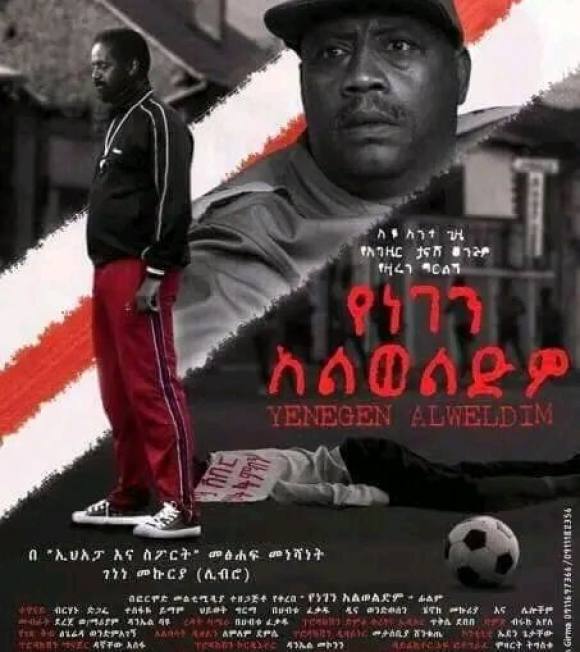
Event Overview Film Ideas Discussion. This event was a specialized discussion focused on the behind-the-scenes filmmaking process of a prominent Ethiopian cinema piece, tracking its journey from conception to final output.
Featured Film: Yenegen Alweldim (የነገን አልወልድም) – translated as "I Won't Give Birth to Tomorrow"
Film Director: Abraham Gezahagne
Discussion Topic: The filmmaking methodology and workflow—covering everything from Pre-production to Post-production.
Event Details
Presenter: Elias Mada, Elias Mada served as the Assistant Director (Assistant Producer) for "Yenegen Alweldim" during its production, bringing firsthand, practical insights to the discussion.
Organizer: Alatinos Ethiopian Filmmakers Association
Date: Thursday, August 18, 2022 (Nehase 12, 2014 E.C.)
Time: 4:30 PM (Local Time: 10:30 ሰዓት)
Venue: Russian Center for Science and Culture (Pushkin Cultural Center), Piazza, Addis Ababa.
Context & Significance: The discussion offered filmmakers, students, and cinema enthusiasts a rare look into the technical and creative hurdles faced during the making of Yenegen Alweldim. Abraham Gezahagne is highly regarded in the Ethiopian film industry for his artistic and narrative depth, making this breakdown of his team's pre-to-post-production pipeline highly valuable for contemporary local cinema development.
Yenegen Alweldim (Amharic: የነገን አልወልድም), which translates to "I Will Not Bear Tomorrow" (or "I Won't Give Birth to Tomorrow"), is a critically acclaimed 2016 Ethiopian feature film written and directed by Abraham Gezahagne.
It stands as a significant milestone in contemporary Ethiopian cinema due to its serious tone, historical weight, and high production value compared to the typical local melodramas of its era.
Core Overview & Background
Director/Writer: Abraham Gezahagne
Release Year: 2016
Running Time: 117 minutes
Language: Amharic (with English subtitles for international screenings)
Source Material: The film is based on a book by the renowned Ethiopian sports journalist Genene Mekuria (commonly known as Libro).
The film is set during one of the darkest and most traumatic chapters in modern Ethiopian history: the Qey Shibir (Red Terror) of 1977–1978. During this period, the ruling military junta (the Derg) violently suppressed political opposition, resulting in widespread fear, surveillance, and mass killings.
Against this backdrop of terror, the narrative cleverly uses football (soccer) as a central theme—serving as a beacon of hope, a psychological escape, and a distraction for ordinary citizens trying to survive the impending danger.
The story follows a protagonist named Adugna, a rising football star. When the young, talented players of his team are suddenly placed under heavy surveillance by government forces, the stakes skyrocket. Adugna's wife, terrified of losing him, desperately pleads with him to quit his passion for football and conform to the regime's demands. However, Adugna faces a brutal catch-22: conforming and giving up his sport would mean being forcibly conscripted into the government's brutal security force.
The title "I Will Not Bear Tomorrow" serves as a powerful metaphor for the generational despair of the era—where the present reality is so bleak and dangerous that bringing children into "tomorrow's" world feels like an unbearable sentence.
Departure from "Boona" Cinema: In the 2000s and 2010s, Ethiopian cinema was heavily dominated by low-budget romantic comedies and family dramas, often referred to locally as "Boona (Coffee) Films." Yenegen Alweldim broke away from this trend by tackling heavy political and historical trauma with cinematic grit.
International Recognition: Because of its nuanced storytelling, the film traveled outside of Ethiopia to international film festivals, including a notable screening and director Q&A at the Film Africa festival in London in November 2017.
Abraham Gezahagne's work on Yenegen Alweldim established him as a premier voice for historical thrillers in East Africa.
Abraham has parlayed his thematic mastery of the 1970s Red Terror era into a massive international co-production titled Mehal Sefari (The In-Between). This project, which shot in Addis Ababa in early 2026, is co-produced across Canada, Norway, Germany, and the Netherlands. It follows a politically apathetic ambulance driver during the 1977 mass killings and features top Ethiopian talent like Girum Zenebe and Abebe Balcha. The technical workflows, pre-production planning, and structural boundaries discussed by his team (like Assistant Director Elias Mada at the Pushkin event) during Yenegen Alweldim laid the crucial groundwork for how Ethiopian cinema is now successfully scaling onto the global co-production stage.